


If you want a simple drink to add to your nighttime routine, tea to drink to sleep can offer a calming option before bed. Herbal teas contain no caffeine when you choose the right ingredients, and the warm ritual can help you slow down at night.
Some herbs also contain compounds that researchers have studied for relaxation and sleep. However, herbal tea does not work like a prescription sleep medicine. Research on many popular sleep herbs remains limited or mixed. For example, recent research suggests that chamomile may improve some measures of sleep quality, while evidence for valerian remains inconsistent.
This guide explains the best herbal teas for sleep, when to drink them, how to brew them, and what safety precautions you should know.
What Tea Can You Drink to Help You Sleep?
The best choices usually include naturally caffeine-free herbal infusions such as:
- Chamomile tea
- Valerian root tea
- Passionflower tea
- Lemon balm tea
- Lavender tea
- Rooibos tea
- Caffeine-free herbal sleep blends
These drinks can fit into a relaxing sleep hygiene routine. They work best as part of a consistent bedtime routine rather than as a guaranteed treatment for insomnia.
What Makes a Tea Suitable for Nighttime?
Look for three qualities:
- No caffeine
- A calming flavor and aroma
- Ingredients with some research behind their traditional sleep use
Check the ingredient label carefully. Some products marketed as nighttime teas contain green tea, black tea, or other caffeinated ingredients.
7 Best Herbal Teas for Sleep
| Tea | Why people use it at night | Evidence | Caffeine |
|---|---|---|---|
| Chamomile | Relaxation and sleep quality | Promising but limited | None |
| Valerian root | Sleep support | Mixed | None |
| Passionflower | Relaxation and sleep | Limited | None |
| Lemon balm | Calm and relaxation | Limited | None |
| Lavender | Relaxing aroma and flavor | Limited for oral tea | None |
| Rooibos | Caffeine-free nighttime drink | Limited sleep evidence | None |
| Herbal sleep blends | Convenient combination | Depends on ingredients | Usually none |
1. Chamomile Tea
Chamomile remains one of the most popular natural sleep aid teas.
Researchers have studied chamomile for anxiety and sleep quality. A 2024 systematic review and meta-analysis included 10 studies involving 772 participants. The researchers found an improvement in overall sleep quality, although chamomile did not consistently improve sleep duration or sleep efficiency.
Chamomile contains flavonoids such as apigenin, which researchers have studied for their interaction with brain receptors. However, you should not interpret apigenin’s biological activity as proof that a cup of chamomile tea will induce sleep.
How to Make Chamomile Tea
Use:
- 1 chamomile tea bag or about 1–2 teaspoons of dried flowers
- 8–10 ounces of hot water
- Steep for about 5–10 minutes
- Cover the cup while it steeps
- Drink it warm
Covering the cup can help retain aromatic compounds, but claims that a specific covering method produces a precise percentage increase in sleep compounds need laboratory testing before you can treat them as established facts.
2. Valerian Root Tea
Valerian root has a long history of traditional use for sleep.
Researchers have studied valerian for insomnia, but the results remain inconsistent. NCCIH notes that the evidence does not clearly establish valerian as an effective treatment for insomnia, and the American Academy of Sleep Medicine previously recommended against valerian for chronic insomnia.
A meta-analysis of randomized trials found some subjective improvement in sleep quality but did not demonstrate a clear improvement in objective sleep measures such as sleep latency.
Because valerian can cause drowsiness, avoid combining it with alcohol or sedative medicines unless your healthcare professional advises you to do so.
3. Passionflower Tea
Passionflower tea can work well for people who associate bedtime with stress or racing thoughts.
Small studies suggest that passionflower may improve total sleep time in adults with insomnia, but researchers have reported mixed results for falling asleep and staying asleep.
Passionflower can also cause drowsiness, dizziness, or confusion. Avoid it during pregnancy unless your healthcare professional specifically recommends it. It can also interact with medicines and anesthesia.
4. Lemon Balm Tea
Lemon balm offers a mild citrus flavor that works naturally in nighttime blends.
Researchers have studied lemon balm for relaxation and stress, but strong clinical evidence for treating insomnia remains limited. You can use it as part of a calming bedtime ritual rather than treating it as a proven insomnia treatment.
Lemon balm also pairs well with chamomile and lavender.
5. Lavender Tea
Lavender can add a floral aroma to a nighttime routine.
People often associate lavender with relaxation, but evidence for lavender tea specifically remains limited. Much of the research focuses on lavender preparations other than tea.
You can still enjoy a caffeine-free lavender infusion as a relaxing beverage if you like its flavor and aroma.
6. Rooibos Tea
Rooibos comes from the Aspalathus linearis plant rather than the traditional tea plant, Camellia sinensis.
That makes rooibos naturally caffeine-free. It provides a useful alternative when you want the comfort of a warm cup without adding caffeine close to bedtime.
Rooibos does not have strong evidence as an insomnia treatment, so think of it as a non-caffeinated night tea, not a clinically proven sleep aid.
7. Caffeine-Free Herbal Sleep Blends
Commercial sleepytime blends often combine ingredients such as:
- Chamomile
- Lemon balm
- Peppermint
- Lavender
- Valerian
- Passionflower
Always read the label before buying one.
Some blends contain several herbs, which makes it difficult to determine which ingredient affects your sleep. Check the serving size and avoid products that contain caffeine if you plan to drink them near bedtime.
What Are the Active Compounds in Sleep Teas?
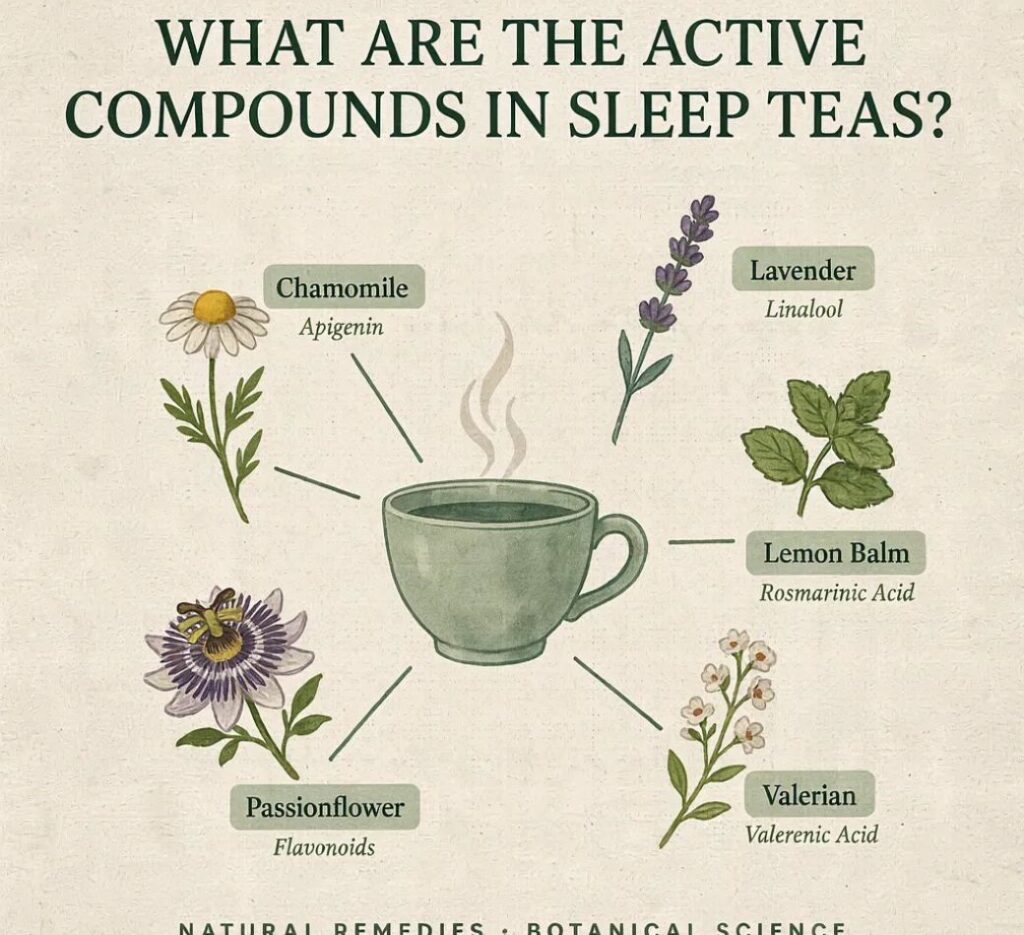
Several compounds commonly appear in discussions about herbal sleep teas.
| Compound | Common source | What researchers study |
|---|---|---|
| Apigenin | Chamomile | Relaxation and receptor activity |
| L-theanine | Green and black tea | Relaxation and sleep outcomes |
| Rosmarinic acid | Lemon balm and other herbs | Antioxidant and biological activity |
| GABA | Naturally occurring neurotransmitter | Nervous-system signaling |
| Essential oils | Lavender and other aromatic herbs | Aroma and relaxation |
L-Theanine
L-theanine occurs naturally in tea leaves from Camellia sinensis. Recent research has examined whether L-theanine supplementation can improve sleep outcomes.
A 2025 systematic review and meta-analysis included 19 articles with 897 participants and found improvements in some subjective sleep measures, including sleep onset latency and overall sleep quality. However, the researchers also noted the need for more research, particularly with pure L-theanine and appropriate doses.
One important point matters here: green tea and black tea contain caffeine. Therefore, they do not automatically qualify as good bedtime teas.
Apigenin
Chamomile contains apigenin, a flavonoid that researchers study for its biological effects.
You may see claims online that apigenin directly produces sleep or dramatically increases melatonin. Those claims often go beyond the available human evidence.
Instead, describe apigenin as one compound found in chamomile that researchers continue to investigate.
GABA
GABA stands for gamma-aminobutyric acid. It acts as an inhibitory neurotransmitter in the central nervous system.
Many herbal sleep products mention GABA-related pathways. However, you should not assume that drinking a tea containing an herb associated with GABA activity will produce the same effect as taking a pharmaceutical sedative.
Does Herbal Tea Increase Melatonin Production?
Some articles claim that specific teas dramatically increase melatonin production. You should treat those statements carefully.
Your body naturally produces melatonin in response to darkness, and your circadian rhythm controls its release. A relaxing nighttime routine can support healthy sleep habits, but you should not assume that a cup of herbal tea directly increases melatonin enough to treat insomnia.
If you regularly struggle to fall asleep or stay asleep, address the underlying sleep problem instead of relying only on tea.
When Is the Best Time to Drink Tea Before Bed?

For most people, about 1–2 hours before bedtime provides a practical starting point.
The ideal timing depends on how your body responds to fluids.
If you drink a large cup immediately before lying down, you may need to urinate during the night. That can interrupt your sleep.
A Practical Nighttime Tea Routine
Try this simple schedule:
2 hours before bed:
Finish caffeinated beverages.
60–90 minutes before bed:
Drink a small cup of caffeine-free herbal tea.
30–60 minutes before bed:
Dim the lights, reduce stimulating activities, and begin your normal bedtime routine.
At bedtime:
Go to bed when you feel sleepy.
Avoid forcing yourself to drink tea if fluids already make you wake frequently during the night.
The American Academy of Sleep Medicine also recommends addressing factors such as caffeine, alcohol, excessive fluids, and stimulating activities when managing sleep problems.
How Much Tea Should You Drink Before Bed?
You do not need a large mug.
A practical serving of around 6–8 ounces (180–240 mL) can provide the ritual without adding excessive fluid close to bedtime.
If nighttime urination bothers you, use a smaller serving and drink it earlier.
Do not treat a fixed fluid limit as a medical rule. Your hydration needs depend on factors such as your health, medications, activity level, and climate.
How to Brew Herbal Tea for Sleep
Brewing method matters for flavor and can influence which compounds enter the water.
For Flowers and Leaves
Use an infusion method:
- Heat fresh water.
- Add the herbs.
- Cover the cup or teapot.
- Steep for about 5–10 minutes.
- Strain and drink.
Chamomile and lavender generally work well with this method.
For Roots
Roots such as valerian often need more preparation than delicate flowers.
Follow the instructions on the commercial product because preparation varies between products. Some root products use a longer steep or decoction method.
Do not assume that a longer steep automatically produces a better sleep effect.
Should You Cover Your Tea While It Steeps?
Yes, covering an herbal infusion can help retain volatile aromatic compounds that can otherwise escape with steam.
However, avoid publishing precise claims such as “covering your tea increases sedative compounds by 22%” unless you have a properly documented laboratory analysis.
For a home recipe, simply covering the cup provides a practical brewing habit.
Can Tea Before Bed Make You Wake Up to Pee?
Yes.
Any beverage adds fluid, and drinking a large amount shortly before bed can increase nighttime urination in some people.
If you experience nocturia, try these adjustments:
- Drink less tea.
- Drink it earlier.
- Avoid large servings immediately before bed.
- Limit caffeinated drinks in the evening.
- Discuss persistent nighttime urination with a healthcare professional.
Frequent nighttime urination can have causes that have nothing to do with tea.
Tea and Sleep Latency: Can It Help You Fall Asleep Faster?
Sleep latency means the time it takes you to fall asleep after you try to sleep.
Some research suggests that certain herbs may influence subjective sleep quality or relaxation, but the evidence varies considerably.
For example, recent chamomile research found improvements in some sleep outcomes, while valerian research has produced inconsistent results.
Therefore, avoid promising that a specific tea will reduce sleep latency by a precise number of minutes.
Instead, use tea as one part of a consistent wind-down routine.
Tea vs. Sleep Hygiene: Which Matters More?
Tea should support your sleep routine, not replace it.
A stronger nighttime routine can include:
- Keeping a consistent wake time
- Limiting caffeine later in the day
- Reducing bright light before bed
- Avoiding heavy meals close to bedtime
- Exercising regularly
- Creating a cool, quiet bedroom
- Using relaxation exercises
- Getting out of bed if you cannot sleep
For chronic insomnia, basic sleep hygiene alone may not provide enough improvement. Evidence-based behavioral treatments, especially CBT-I and related approaches, play a much more important role.
What Tea Should You Avoid Before Bed?
Avoid or limit teas that contain significant caffeine, including:
- Black tea
- Green tea
- Matcha
- Yerba mate
- Many energy teas
- Some chai blends
Caffeine can interfere with sleep even when you drink it several hours before bed. One controlled study found that 400 mg of caffeine affected sleep when participants consumed it 6 hours before bedtime.
If you are sensitive to caffeine, set an earlier personal cutoff.
Are Sleepytime Tea Ingredients Safe?
Most common herbal tea ingredients have a history of food use, but “natural” does not automatically mean risk-free.
Chamomile Safety
Chamomile can cause allergic reactions, especially in people who react to ragweed, chrysanthemums, marigolds, or daisies. It may also interact with certain medicines, including warfarin and some sedatives.
Valerian Safety
Valerian can cause drowsiness and should not be combined with alcohol or sedative medicines without professional guidance. Researchers also have limited information about long-term safety.
Passionflower Safety
Passionflower may cause drowsiness, dizziness, or confusion. It can also interact with medicines and anesthesia. Avoid it during pregnancy unless a healthcare professional specifically recommends it.
If you take prescription medicines, become pregnant, breastfeed, have a chronic condition, or plan surgery, ask a healthcare professional before using medicinal-strength herbal products.
How to Choose the Best Tea for Your Sleep Problem
Different teas may fit different preferences.
| Your nighttime concern | Tea to consider | Important note |
|---|---|---|
| You want a simple bedtime ritual | Chamomile | Evidence remains limited but promising |
| You want a caffeine-free option | Rooibos | Not a proven insomnia treatment |
| You feel stressed at bedtime | Passionflower | Evidence remains limited |
| You want a traditional sleep herb | Valerian | Research results are inconsistent |
| You prefer floral flavors | Lavender | Sleep evidence remains limited |
| You want a mild citrus flavor | Lemon balm | More research is needed |
| You want a blend | Chamomile + lemon balm | Check every ingredient |
A Simple Sleep Tea Routine
You can create a consistent routine without complicated recipes.
90 Minutes Before Bed
Prepare a small cup of caffeine-free herbal tea.
60 Minutes Before Bed
Drink your tea slowly instead of consuming it quickly.
30 Minutes Before Bed
Lower the lights and stop stimulating activities.
At Bedtime
Keep your bedroom dark, quiet, and comfortable.
Frequently Asked Questions
What is the best tea to drink to sleep?
Chamomile is one of the most popular options, and recent research suggests that it may improve some aspects of sleep quality. However, researchers have not established it as a guaranteed treatment for insomnia.
What herbal tea helps you sleep the most?
No single herbal tea works best for everyone. Chamomile, valerian, and passionflower have all received research attention, but their evidence differs and remains limited or inconsistent.
What is the best time to drink tea before bed?
Try drinking a small serving about 60–90 minutes before bed. Move it earlier if nighttime urination disrupts your sleep.
Does chamomile tea really help you sleep?
Research suggests that chamomile may improve some measures of sleep quality. A 2024 meta-analysis found improvements in overall sleep quality, but the researchers did not find consistent improvements in sleep duration or efficiency.
Can I drink valerian root tea every night?
Do not assume that daily long-term use is safe. NCCIH notes that evidence about valerian’s effectiveness remains inconsistent and that researchers know little about long-term safety.
Is sleepytime tea caffeine-free?
Many sleepytime blends contain no caffeine, but you should always check the ingredient label. Some blends may contain traditional tea leaves or other caffeinated ingredients.
Can herbal tea increase melatonin?
Do not assume that herbal tea directly increases melatonin enough to treat sleep problems. Evidence varies by herb, preparation, and study design.
Can I drink tea before bed if I wake up to pee?
You can try a smaller serving earlier in the evening. If frequent nighttime urination continues, discuss it with a healthcare professional rather than simply restricting fluids.
Is L-theanine good for sleep?
Recent systematic-review evidence suggests that L-theanine may improve some subjective sleep outcomes, including sleep onset latency and overall sleep quality. However, researchers still need more high-quality studies to determine the best dose and long-term role.
When Should You Talk to a Doctor About Sleep Problems?
Tea can complement a healthy routine, but it should not delay proper care.
Talk with a healthcare professional if you:
- Regularly struggle to fall asleep
- Wake repeatedly during the night
- Wake too early and cannot return to sleep
- Feel excessively tired during the day
- Snore loudly or gasp during sleep
- Depend on alcohol or sedatives to sleep
- Experience persistent nighttime urination
- Have insomnia that continues despite changing your routine
Chronic insomnia often requires more than basic sleep-hygiene changes. Evidence-based behavioral treatment can provide a more appropriate long-term strategy.
Conclusion
The best tea to drink to sleep depends on your preferences, caffeine sensitivity, sleep habits, and overall health.
Chamomile offers one of the better-studied options, although researchers still need stronger evidence. Valerian has a long history of traditional use but produces inconsistent clinical results. Passionflower may support relaxation for some people, while lemon balm, lavender, and rooibos can provide pleasant caffeine-free alternatives.
For the best results, treat herbal tea as part of a complete sleep hygiene routine rather than a standalone cure. Choose a caffeine-free blend, drink a modest amount about 60–90 minutes before bed, and maintain a consistent wind-down routine.
If sleep problems continue, focus on the underlying cause and consider evidence-based treatment instead of relying on tea alone.
Medical Disclaimer: This article provides general educational information and does not diagnose or treat insomnia or another medical condition. Herbal products can interact with medicines and may not suit everyone. Speak with a qualified healthcare professional before using medicinal-strength herbal products, especially during pregnancy, breastfeeding, before surgery, or while taking medication.