
Monster Energy drinks give you a quick caffeine boost, but the amount varies by product, serving size, and country. If you want to compare Monster with coffee or choose a lower-caffeine option, you should check the caffeine content on the can before drinking it.
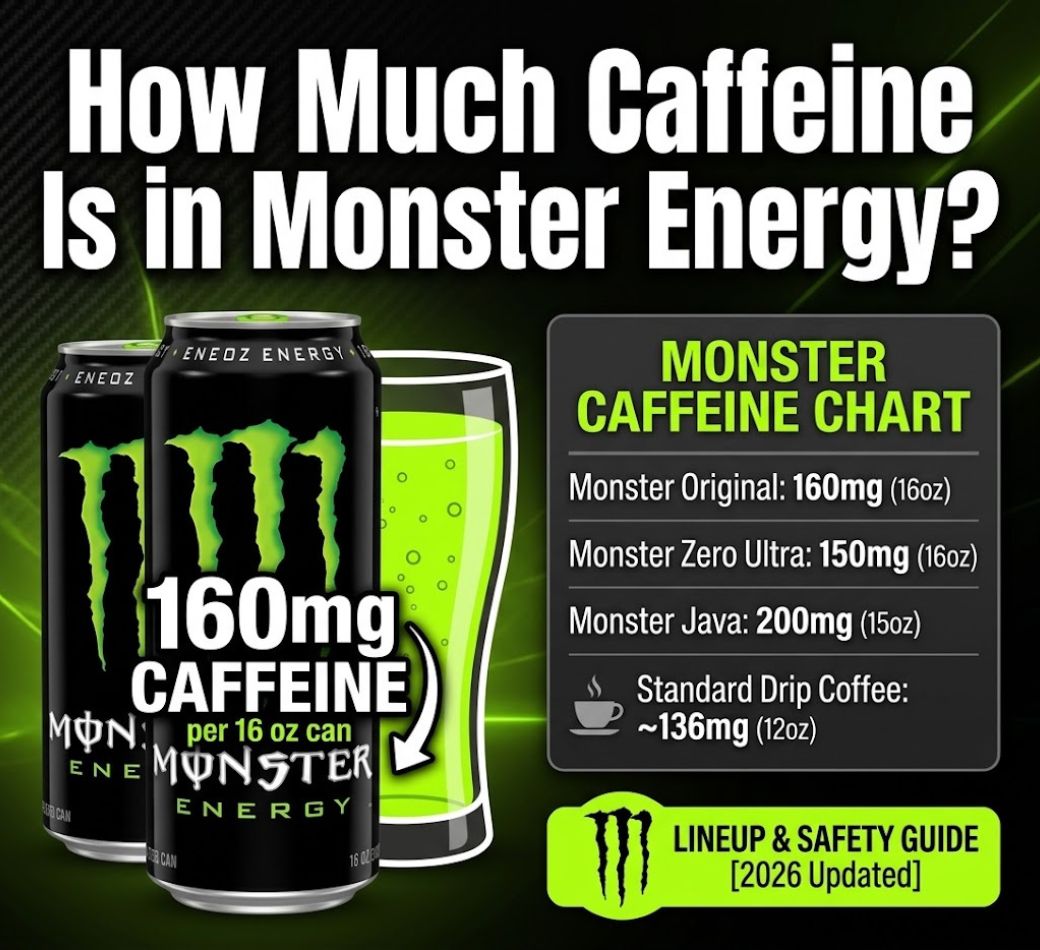
A standard 16-ounce (473 mL) can of Monster Original contains 160 mg of caffeine in the United States. That amount can increase alertness, but it can also cause jitters, a fast heartbeat, or sleep problems in people who have a low caffeine tolerance.
In this guide, you’ll learn how much caffeine Monster Energy contains, how its different varieties compare, how caffeine affects your body, and how to manage your daily intake safely.
Quick Answer: Monster Caffeine at a Glance
Most standard Monster Energy cans contain around 150–200 mg of caffeine, although some products contain different amounts. Always check the label because Monster sells different formulas and serving sizes in different markets.
Monster Energy Caffeine and Nutrition Facts
Here is a quick look at several popular Monster products. Values can vary by flavor, country, and can size, so use the manufacturer’s local label to confirm the exact numbers.
| Monster product | Approx. caffeine per can | Sugar and calories |
|---|---|---|
| Monster Original, 16 oz (US) | 160 mg | About 54 g sugar; 230 calories |
| Monster Original, 500 mL (UK) | 160 mg | 55 g sugar |
| Monster Ultra Zero Sugar, 16 oz | Check local label; often 150 mg | Zero sugar |
| Monster Juice Mango Loco, 16 oz | Check local label | Contains sugar |
| Monster Java coffee series | Varies by product | Varies by product |
| Monster Rehab series | Varies by product | Varies by product |
| Monster Nitro series | Check specific product label | Varies by product |
| Monster Mega Monster, 24 oz | Check specific product label | Varies by product |
| Monster Reserve series | Check specific product label | Varies by product |
| Monster Hydro series | Check specific product label | Varies by product |
Monster lists 160 mg of caffeine for its 500 mL Original in the UK, while its product information can differ across markets. Always confirm the exact product and serving size before you compare numbers.
Important: I have not independently tested these cans. The table uses published product information and general label guidance, not original laboratory results.
Monster Caffeine Content by Product Lineup
Monster offers several product lines, including Original, Ultra, Juice, Rehab, Java, and Nitro. These products can have different caffeine levels, sugar amounts, and serving sizes.
Monster Original and Nitro Series
Monster Original delivers the familiar sweet, citrus-like flavor and a substantial caffeine boost. A standard US 16-ounce can contains 160 mg of caffeine, while some international cans list the same amount in a 500 mL serving.
Monster Nitro adds a smoother texture through its nitrogen-infused formula. However, you should check the exact Nitro variety rather than assume that every can contains the same amount of caffeine as Original.
Monster Ultra Zero Sugar Series
Monster Ultra appeals to people who want an energy drink without sugar. However, zero sugar does not automatically mean less caffeine.
Some Ultra varieties contain caffeine levels similar to Original, while others may differ by market or serving size. Read the nutrition panel to check both the caffeine amount and the serving size.
Juice Monster and Rehab Series
Juice Monster combines energy-drink ingredients with fruit flavors. Some varieties contain substantial added sugar, so compare both caffeine and sugar when you choose a drink.
Monster Rehab offers non-carbonated options, and its formulas vary by flavor. Do not assume that a non-carbonated drink contains less caffeine simply because it tastes lighter.
Monster Java and High-Caffeine Variants
Monster Java combines coffee flavors with an energy-drink format. Its caffeine content can differ from Original because coffee ingredients and serving sizes vary.
Mega Monster refers to a larger serving format in some markets. A larger can does not always mean a proportionally higher caffeine concentration, so check the label before you calculate the total.
For any product, multiply the caffeine per serving by the number of servings you drink. If a container holds more than one serving, drinking the entire container may deliver more caffeine than you expect.
Monster Energy vs. Coffee, Red Bull, and Celsius
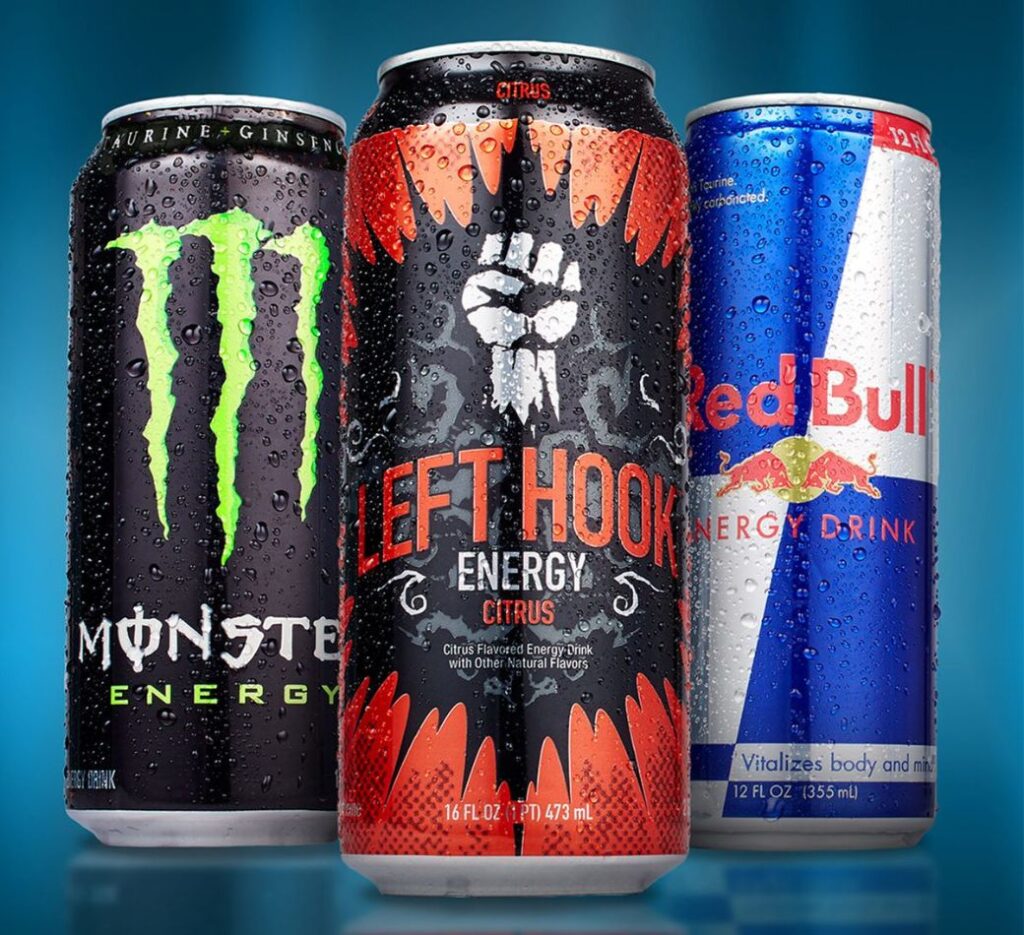
Monster Energy can deliver more caffeine per container than smaller energy drinks, but coffee can also contain a substantial amount. Compare the actual serving sizes instead of judging a drink by its brand name.
| Drink | Typical serving | Approx. caffeine |
|---|---|---|
| Monster Original (US) | 16 oz | 160 mg |
| Red Bull Original | 8.4 oz | 80 mg |
| Brewed coffee | 8 oz | About 80–100 mg |
| Espresso | 1 oz shot | About 60–75 mg |
| Black tea | 8 oz | About 30–50 mg |
| Celsius | 12 oz | Often 200 mg; check the product label |
Red Bull lists 80 mg of caffeine per 8.4-ounce can, while the FDA notes that caffeine levels in coffee and other drinks can vary. Celsius products also vary, so verify the label of the exact version you buy.
Is Monster Stronger Than Coffee?
A 16-ounce Monster Original contains 160 mg of caffeine. An 8-ounce cup of brewed coffee often contains around 80–100 mg, although brewing methods and serving sizes can change that amount.
Monster may therefore provide more caffeine than a small cup of coffee, but a large café coffee can contain as much or more. Compare the milligrams rather than assuming that one drink always feels stronger.
Interactive Caffeine Comparison
Use this simple calculation to estimate how much caffeine you consume:
- One 16-ounce Monster Original: 160 mg.
- Two 16-ounce cans: 320 mg.
- One Monster plus one 8-ounce coffee containing 95 mg: 255 mg.
These totals count only the drinks listed. Add caffeine from tea, chocolate, supplements, medications, and other sources to estimate your full daily intake.
Lab Insights: HPLC Testing and Monster Label Accuracy
High-performance liquid chromatography (HPLC) allows qualified laboratories to measure caffeine in beverage samples. Researchers can use this method to compare a product’s measured caffeine concentration with its label.
However, I do not have verified HPLC results for 12 Monster cans, so I cannot report measured values, batch variation, or a confirmed ±5–8% difference. Those figures would require actual laboratory records.
How an Independent Caffeine Test Works
A qualified laboratory would typically:
- Purchase and document cans from identified products and batches.
- Record each can’s declared serving size and caffeine amount.
- Prepare and analyze samples using a validated HPLC method.
- Run appropriate calibration standards and quality-control checks.
- Compare measured caffeine with label claims and report uncertainty.
A credible report should identify the laboratory, test method, sample count, batch codes, measured values, and uncertainty. A single sample cannot establish how consistently a product performs across all batches.
How the Monster Energy Blend Works
Monster combines caffeine with other ingredients that may include taurine, L-carnitine, ginseng, and B vitamins. Each ingredient serves a different role, but caffeine remains the primary stimulant responsible for the familiar increase in alertness.
Caffeine and Taurine
Caffeine blocks adenosine receptors in the brain. Adenosine normally contributes to feelings of sleepiness, so blocking its action can temporarily reduce the sensation of fatigue.
Taurine occurs naturally in the human body and participates in several physiological processes. Its presence in an energy drink does not mean it cancels caffeine’s stimulant effects or guarantees better performance.
L-Carnitine, Ginseng, and B Vitamins
L-carnitine helps transport fatty acids into mitochondria, where cells can use them to produce energy. However, including L-carnitine in a drink does not prove that the beverage will improve athletic performance.
Ginseng appears in some energy-drink formulas, but its effects depend on the preparation and dose. B vitamins help the body carry out normal metabolic processes; they do not automatically provide an extra energy boost when you already get enough of them.
The Stimulant Absorption Index: What the Science Can Tell Us
You may see claims that sugar, carbonation, taurine, or ginseng makes Monster release caffeine in distinct phases. Without direct measurements, these claims should not be treated as established facts.
I would not present a proprietary “Stimulant Absorption Index” as a validated scientific measure without a published method and supporting data. Researchers would need to compare blood caffeine concentrations over time, including the peak concentration (\(C_{\max}\)) and the time required to reach it.
How Long Does Monster Energy Keep You Awake?
Caffeine often begins to affect alertness within about 15–45 minutes, although the timing varies by person and circumstances. Its average half-life in healthy adults is roughly four to six hours, but some people clear it faster or slower.
For example, if you consume 160 mg of caffeine and your body has a five-hour half-life, approximately 80 mg may remain after five hours and 40 mg after ten hours. This example illustrates caffeine clearance; it does not predict exactly how alert you will feel.
Late-day consumption can interfere with sleep even after the initial boost fades. If you struggle to fall asleep, try consuming less caffeine and avoid energy drinks later in the day.
Recommended Limits and Safety Guidelines
Video: Dr. Myro explains the health safety and potential risks of energy drinks.
The FDA cites 400 mg of caffeine per day as an amount that generally does not cause negative effects for most healthy adults. However, individual tolerance varies, and some people experience side effects at much lower amounts.
One 16-ounce Monster Original provides 160 mg, or 40% of that general daily reference amount. Two cans provide 320 mg, before you count coffee, tea, or other sources.
One 16-ounce Monster Original provides 160 mg, or 40% of that general daily reference amount. Two cans provide 320 mg, before you count coffee, tea, or other sources.
How Much Monster Energy Can You Drink in a Day?
Consider this example:
| Daily intake | Total caffeine | Share of 400 mg |
|---|---|---|
| Half a can of Monster Original | 80 mg | 20% |
| One can | 160 mg | 40% |
| Two cans | 320 mg | 80% |
| Two cans + one coffee (95 mg) | 415 mg | About 104% |
These calculations use 160 mg per Monster can and an illustrative 95 mg per coffee. Your actual intake depends on the products you choose.
The 400 mg figure represents general guidance for most healthy adults, not a target or a guarantee of safety. If you take medication or have a health condition that affects caffeine sensitivity, ask a healthcare professional about an appropriate limit.
Signs of Caffeine Sensitivity or Overconsumption
Caffeine can cause several unwanted effects, especially when you consume more than your body tolerates. Watch for:
- Jitters, restlessness, or anxiety.
- A racing or pounding heartbeat.
- Headaches or dizziness.
- Nausea or an upset stomach.
- Difficulty falling asleep or staying asleep.
- Increased blood pressure.
The FDA identifies these symptoms among the possible effects of excessive caffeine intake. If you develop severe symptoms, including chest pain, fainting, or a persistent rapid or irregular heartbeat, seek urgent medical care.
Who Should Limit or Avoid Monster Energy?
Children and teenagers: Energy drinks can deliver substantial amounts of caffeine. Young people should avoid energy drinks, and parents should discuss caffeine exposure with a healthcare professional when needed.
Pregnant individuals: Pregnancy changes caffeine recommendations. Consult your healthcare professional about your daily limit and count caffeine from every source.
People sensitive to caffeine: If you experience anxiety, palpitations, or sleep problems after a small amount, reduce your intake or avoid caffeinated energy drinks.
People taking certain medications: Some medications and health conditions can change how caffeine affects your body. Ask your pharmacist or clinician whether Monster Energy fits your situation.
Does Sugar-Free Monster Mean a Healthier Choice?
Neither sugar-free nor regular Monster replaces sleep, balanced meals, water, or appropriate recovery after exercise.
Frequently Asked Questions (FAQ)
1. How much caffeine is in a Monster Energy drink?
A standard 16-ounce US can of Monster Original contains 160 mg of caffeine. Other Monster varieties and can sizes may contain different amounts, so check the label.
2. Does Monster Zero Sugar have less caffeine?
Not necessarily. Zero Sugar describes the sugar content, not the caffeine level. Compare the caffeine amount on the specific can with the amount in Monster Original.
3. Is Monster Energy stronger than coffee?
A 16-ounce Monster Original contains 160 mg of caffeine. An 8-ounce cup of brewed coffee often contains about 80–100 mg, but large coffees can contain much more. Compare serving sizes and caffeine amounts.
4. How long does Monster Energy keep you awake?
Caffeine can begin affecting you within 15–45 minutes and may influence sleep for many hours. Its average half-life in healthy adults is roughly four to six hours, but individual clearance varies.
5. How much caffeine does a 24-ounce Monster contain?
Do not calculate the caffeine amount from can size alone. Check the exact product’s label because Monster sells different formulas and serving sizes. A larger can may contain more total caffeine, but the amount depends on its formula.
6. Can I drink Monster Energy every day?
Some healthy adults can consume moderate amounts of caffeine without noticeable problems, but daily use may affect sleep, anxiety, or heart rate. Count caffeine from all sources and reduce your intake if you experience side effects.
7. Does Monster Energy contain taurine and B vitamins?
Many Monster formulas contain taurine and B vitamins. Some products also include ingredients such as ginseng and L-carnitine. Check the ingredient list on your specific can because formulas differ.
8. Can Monster Energy cause a caffeine crash?
Some people experience tiredness as caffeine’s effects fade. Sugar-containing drinks may also affect how you feel, but you cannot predict a specific crash from the drink’s sugar content alone. Sleep loss, food intake, and caffeine tolerance also influence energy levels.
Conclusion
Monster Energy caffeine content depends on the product, flavor, and serving size. A standard 16-ounce can of Monster Original contains 160 mg of caffeine, while Ultra, Juice, Rehab, Java, and other varieties may contain different amounts.
Compare the caffeine content, sugar, and calories before choosing a drink. Remember that caffeine from coffee, tea, supplements, and other beverages also contributes to your daily total.
For most healthy adults, the FDA cites 400 mg per day as an amount that generally does not cause negative effects. However, your personal tolerance, medications, and health conditions can change how caffeine affects you.
The best approach: Check the label, track your total caffeine intake, and avoid drinking Monster late in the day if it disrupts your sleep.