
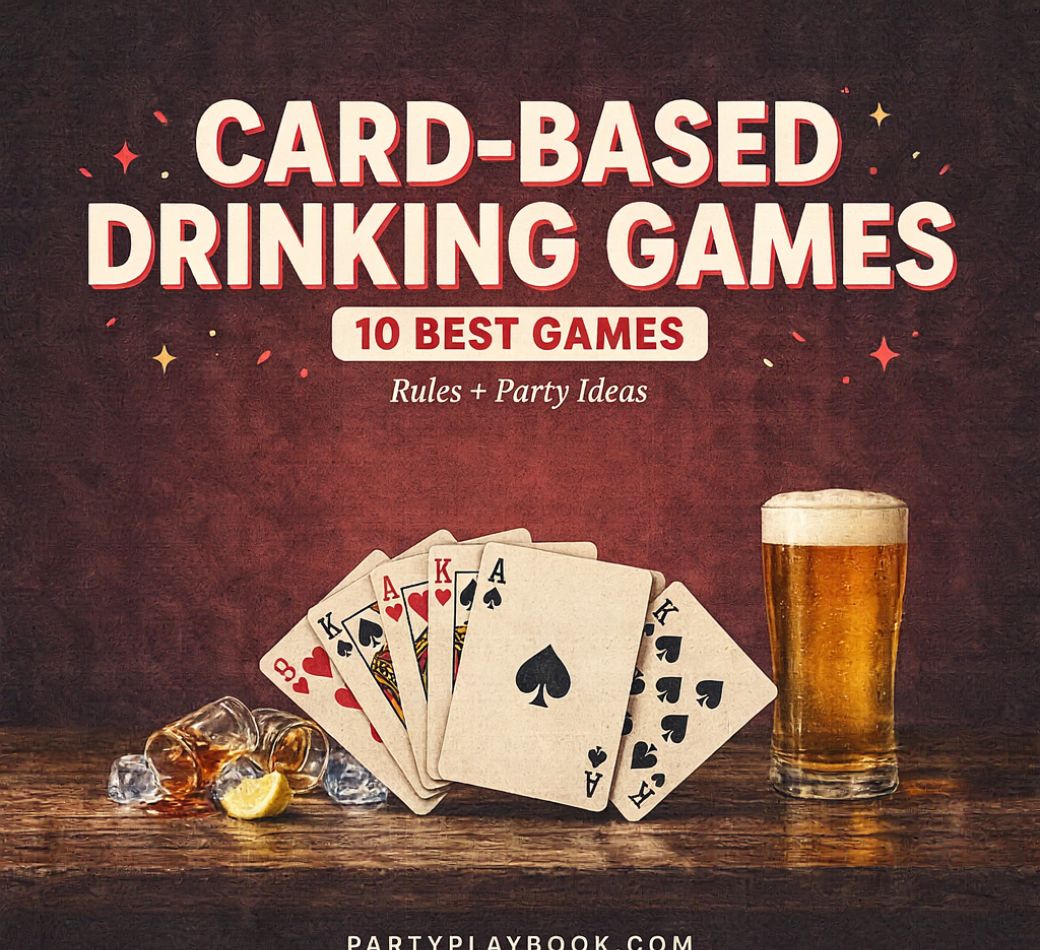
Card-based drinking games turn an ordinary deck of playing cards into an easy party activity. Most games require only a standard 52-card deck, drinks, and a group of friends. You can choose simple games for beginners or more strategic options for experienced players.
This guide covers the best card-based drinking games, explains the rules and setup, and shows you how to adapt these games for two players or non-alcoholic gatherings.
Drink responsibly: Alcohol can impair judgment and coordination. Use small portions, take breaks, drink water, and never pressure anyone to drink. You can replace alcohol with water, soda, juice, or another non-alcoholic drink.
What Are Card-Based Drinking Games?
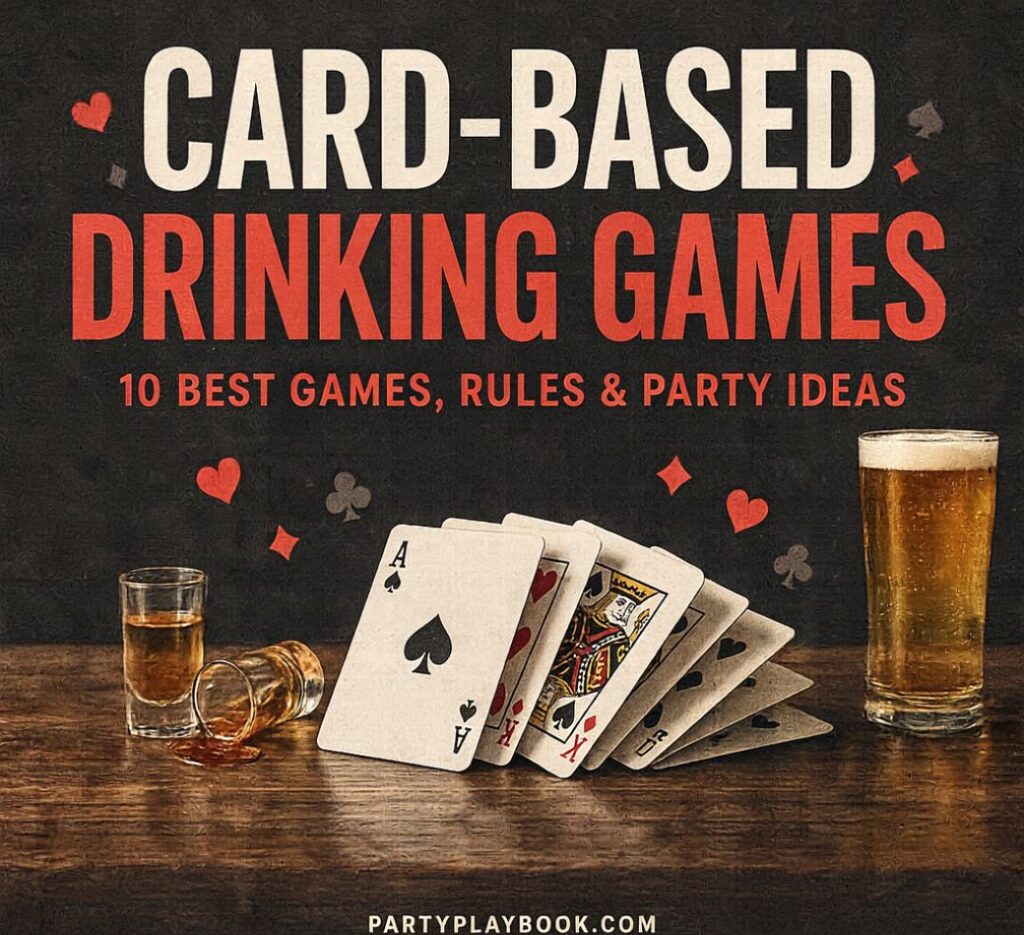
Card-based drinking games use playing cards to assign actions, challenges, questions, or drink penalties. Players usually take turns drawing cards and following the rule connected to each card.
A standard deck works well because players can easily assign a different action to each card value. You can also create house rules to match your group and keep the game simple.
Most games fall into three categories:
- Rule-based games: Each card triggers a specific action.
- Guessing games: Players predict card colors, suits, or values.
- Strategy games: Players make choices that affect later rounds.
These games work well at casual parties because they require little equipment and allow several people to participate.
What You Need to Play
You can start most card-based drinking games with a few basic items.
| Item | Purpose |
|---|---|
| Standard 52-card deck | Provides the cards for gameplay |
| Drinks | Serve as optional penalties or rewards |
| Cups or glasses | Give each player a personal drink |
| Table or flat surface | Keeps cards organized |
| Water | Helps players stay hydrated |
| Non-alcoholic drinks | Provide an alcohol-free option |
You do not need expensive equipment or a special card deck. A regular playing-card deck works for many popular games.
Best Card-Based Drinking Games
The following games offer different levels of strategy, speed, and social interaction. Choose one based on your group size and preferred style.
1. Kings Cup / Ring of Fire
Players: 4–10+
Setup: About 2 minutes
Equipment: One standard deck and a center cup
Kings Cup, also called Ring of Fire, ranks among the most recognizable standard deck drinking games. Players arrange cards around a central cup and take turns drawing cards.
A common rule set looks like this:
| Card | Action |
|---|---|
| 2 | You — choose another player |
| 3 | Me — take a drink |
| 4 | Floor — last player to touch the floor takes the penalty |
| 5 | Group rule — assign a group-based action |
| 6 | Group rule — assign another group-based action |
| 7 | Heaven — last player to raise a hand takes the penalty |
| 8 | Mate — choose a drinking partner |
| 9 | Rhyme — start a rhyming chain |
| 10 | Categories — name items from a category |
| J | Make a Rule — create a rule |
| Q | Question Master — players who answer your questions take a penalty |
| K | King — follow the group’s King rule |
| A | Waterfall — begin a sequential drinking action |
House rules vary widely, so agree on the card actions before you begin.
2. Ride the Bus
Players: 3–8
Setup: About 3 minutes
Ride the Bus combines guessing, memory, and probability. Players answer a series of card questions before they enter the final round.
A common opening sequence asks players to predict:
- Red or black
- Higher or lower
- Inside or outside
- Suit
Players reveal a card after each prediction. When a player makes an incorrect prediction, the group applies its agreed penalty.
The final stage uses a card pyramid in many versions. Rules vary, so establish the exact sequence before playing.
3. Fuck the Dealer
Players: 3–6
Setup: Less than 1 minute
This guessing game uses one player as the dealer. The dealer holds the deck and asks another player to guess the value of a card.
A simple version works like this:
- The dealer draws one card without showing it.
- The player guesses the card’s value.
- The dealer tells the player whether the guess was higher or lower.
- The player makes another guess.
- The group applies its agreed penalty when the player misses.
After several failed guesses, the dealer can pass the role to another player according to the house rules.
4. Pyramid
Players: 3–8
Setup: About 2 minutes
Pyramid uses face-down cards arranged in rows. Players receive cards in their hands and try to match them with cards revealed from the pyramid.
A common setup uses five rows:
- 1 card in the first row
- 2 cards in the second row
- 3 cards in the third row
- 4 cards in the fourth row
- 5 cards in the bottom row
Reveal the pyramid row by row. When a revealed card matches a card in a player’s hand, that player can follow the agreed penalty or challenge rule.
5. High or Low
Players: 2–8
Setup: Less than 1 minute
High or Low offers one of the simplest ways to start a card game.
- Shuffle the deck.
- Place one card face-up.
- Ask the next player whether the following card will rank higher or lower.
- Reveal the next card.
- Apply the agreed penalty when the player guesses incorrectly.
- Continue around the table.
You can add a special rule for ties to avoid arguments during play.
6. Across the Bridge
Players: 2–6
Setup: About 1 minute
Across the Bridge uses a row of cards and asks players to work their way across them. Different versions use different layouts and penalties.
For a simple version, place several cards face-down in a line. Players turn over cards one at a time and follow your predetermined rules for each card.
You can add higher penalties or special challenges to particular cards.
7. Spoons Variation
Players: 3–8
Setup: About 2 minutes
Traditional Spoons focuses on collecting four cards of the same rank and grabbing a spoon before the other players. You can add a drinking-game variation without changing the basic card mechanics.
Set one fewer spoon than the number of players. Deal four cards to each player and pass cards around the table. When someone collects four of a kind, they grab a spoon. Everyone else follows.
The player who fails to grab a spoon can receive the group’s agreed non-alcoholic or optional drink penalty.
8. Drunk Jacks
Players: 3–8
Setup: About 1 minute
Drunk Jacks uses the Jack cards as the central mechanic. Before starting, create a rule for what happens whenever someone draws a Jack.
For example, you can assign:
- A question challenge
- A quick trivia question
- A category challenge
- A temporary rule
- An optional drink penalty
Because house rules differ, explain your Jack rules before the first round.
9. High-Intensity Guessing Game
Players: 2–6
Setup: About 1 minute
You can create your own guessing game with a standard deck. Ask players to predict card colors, suits, or values before revealing each card.
Keep the rules simple:
- Correct prediction = continue
- Incorrect prediction = apply the agreed penalty
- Special card = trigger a bonus challenge
This format lets you build a quick game around your group’s preferred rules.
10. Custom 52-Card Party Game
Players: 3–10+
Setup: 5 minutes
A custom deck gives you complete control over the experience. Assign an action to every card value and explain the rules before starting.
For example:
| Card Group | Suggested Action |
|---|---|
| 2–4 | Simple player challenges |
| 5–7 | Group actions |
| 8–10 | Word and category games |
| J | Create a rule |
| Q | Ask questions |
| K | Trigger a special round |
| A | Start a group action |
Keep penalties optional and let players choose non-alcoholic alternatives.
Best Standard Deck Drinking Games for Different Group Sizes

Your group size can determine which game works best.
| Group Size | Games to Consider | Why They Work |
|---|---|---|
| 2 players | High or Low, custom guessing games | Simple turn structure |
| 3–4 players | Fuck the Dealer, Pyramid | Quick and interactive |
| 5–6 players | Ride the Bus, Spoons | Keeps everyone involved |
| 7–10 players | Kings Cup, Ring of Fire | Supports larger groups |
| 10+ players | Kings Cup or custom rules | Easy to scale |
You can also split a large group into smaller tables when a game requires more individual attention.
Card Drinking Games for Two
You do not need a large group to enjoy card-based games. Several formats work with two players.
High or Low for Two
Take turns predicting whether the next card will rank higher or lower. Add a simple challenge for incorrect guesses.
Two-Player Dealer Game
One player acts as the dealer while the other guesses card values. Switch roles after each round.
Two-Player Custom Deck
Assign different challenges to card values and take turns drawing cards. You can make the game competitive by awarding points instead of using drink penalties.
How to Set Up Kings Cup
Kings Cup works best when everyone understands the rules before the first card gets drawn.
Step 1: Place the Center Cup
Put an empty cup in the center of the table. Use a separate personal glass for each player.
Step 2: Arrange the Cards
Place the cards face-down in a circle around the center cup. Leave enough space for players to draw cards without knocking over the setup.
Step 3: Explain the Card Rules
Read through the card actions before starting. Give players a chance to suggest house rules.
Step 4: Draw Cards
Players take turns drawing one card and immediately follow the assigned action.
Step 5: Handle Special Cards
Keep temporary roles or rules active for the duration you agreed upon.
Step 6: End the Game
Choose a clear ending condition before you begin. You can stop after a set number of rounds or when the deck runs out.
Tip: You do not need to use a shared alcoholic drink. A shared cup can create hygiene concerns, so you can replace it with a visual marker, empty cup, or non-alcoholic setup.
Common House Rules and Variations
House rules can make familiar games feel new. However, unclear rules can slow down gameplay, so explain every variation before the round begins.
Add a Points System
Give each player 10 or 20 points. Assign points to different challenges instead of using alcohol.
Use Challenge Cards
Assign tasks such as:
- Name three movies in five seconds.
- Give another player a compliment.
- Answer a trivia question.
- Speak without using a specific word for one round.
- Perform a harmless impression.
Create a Theme
Build the deck around a theme such as movies, music, sports, travel, or general trivia.
Add a Timer
Give players five or ten seconds to complete certain challenges. A timer can increase the pace without increasing alcohol consumption.
Non-Alcoholic Card Game Alternatives
You can enjoy these games without alcohol. Replace drink penalties with points, challenges, tokens, or non-alcoholic beverages.
Here are several options:
| Alcohol-Based Penalty | Non-Alcoholic Alternative |
|---|---|
| Take a drink | Lose 1 point |
| Take two drinks | Lose 2 points |
| Choose someone to drink | Choose someone for a challenge |
| Group drinks | Group trivia question |
| Special penalty | Take a challenge token |
You can also use soda, juice, sparkling water, or another preferred beverage.
This approach keeps the card mechanics while removing alcohol from the game.
Tips for Safer, Smoother Gameplay

Good party games should keep everyone comfortable and involved.
Set Limits Before Playing
Decide how long you want to play and what penalties you will use. Avoid rules that pressure people to consume alcohol.
Keep Water Available
Place water on the table and encourage regular breaks. Players can also alternate alcoholic drinks with water or choose non-alcoholic drinks throughout the game.
Never Pressure Anyone to Drink
Players should have the freedom to skip alcohol without explaining themselves. A point penalty or challenge can replace a drink penalty.
Never Mix Drinking With Driving
Anyone who drinks should avoid driving. Arrange a designated driver, rideshare, taxi, or another safe way home before the party starts.
Stop When Someone Shows Signs of Intoxication
Do not encourage an intoxicated person to keep drinking. Move away from the game and prioritize their safety.
Keep the Rules Clear
Frequently Asked Questions
What are card-based drinking games?
Card-based drinking games use playing cards to create challenges, guessing rounds, rules, or optional drink penalties. You can play many of them with a standard 52-card deck.
What is the most popular card drinking game?
Kings Cup, also called Ring of Fire, remains a widely recognized format. Its simple card-based rules allow groups to create their own variations.
Can you play card drinking games with two people?
Yes. High or Low, dealer-style guessing games, and custom card games can work well with two players.
What deck do you need for drinking card games?
Most games use a standard 52-card deck. Some variations may use fewer cards or a specialized deck.
How do you play Kings Cup?
Players arrange cards around a center cup, take turns drawing cards, and follow the action assigned to each card. Groups can create their own house rules.
What can you use instead of alcohol?
You can use water, soda, juice, sparkling water, points, tokens, trivia questions, or harmless challenges.
Are card drinking games safe?
Alcohol can create health and safety risks, especially when players consume too much. Set limits, offer non-alcoholic options, provide water, and never pressure anyone to drink.
What is a good card drinking game for a large group?
Kings Cup or Ring of Fire can accommodate larger groups because players can take turns around one table. A custom deck can also work when you want to include more players.
Conclusion
Card-based drinking games offer a simple way to turn an ordinary deck into a social party activity. Kings Cup, Ride the Bus, Fuck the Dealer, Pyramid, High or Low, and other standard deck games each bring different rules and gameplay styles.
Choose a game based on your group size, available time, and preferred level of strategy. Most importantly, keep alcohol optional, establish clear rules, provide non-alcoholic alternatives, and let every player decide what works for them.
With a standard deck and a few creative house rules, you can build an engaging card game without complicated equipment or preparation.